REVIEW · GDANSK
Islands of Gdansk Private Kayak Tour
Book on Viator →Operated by Around Gdansk | Kayak Tours & Adventures · Bookable on Viator
Kayaking Gdansk changes what you notice. You’ll glide along the Motława River, then paddle around Granary Island and Ołowianka Island, seeing the city’s waterways from a perspective you can’t get on foot. I also love how the trip is built for newcomers, with real coaching on simple paddling techniques before you head out.
One consideration: you must be able to swim, and you’ll attend a mandatory safety briefing before getting on the water.
Key things to look forward to
- Private group format so you paddle with just your party
- Motława River route with views shaped by sea-and-river trade
- Two islands: Granary Island and Ołowianka Island
- Gdansk waterfront stops including the Crane, SS Sołdek, and the Remontowa Shipyard area
- Beginner-friendly guidance to help you feel steady fast
- Comfort-minded gear such as high-quality equipment, with some groups provided a dry suit and life vests
In This Review
- Entering the Motława: Why Water-Level Views Matter in Gdansk
- Your Route: Crane, SS Sołdek, and the Remontowa Shipyard Area
- The Crane: A medieval “human-powered” workhorse
- SS Sołdek: A coal and ore freighter story
- Remontowa Shipyard: Watching work in progress
- Granary Island and Ołowianka Island: The Best Part of the Paddle
- Beginner-Friendly Coaching That Actually Helps
- Safety Briefing, Swimming Requirement, and the Rules That Keep It Smooth
- Gear and Comfort: What You’ll Actually Feel During Those 2–3 Hours
- Timing and Effort: Plan for a Workout, Not a Float
- Price and Value: What $145.12 Is Paying For
- Who This Tour Fits Best (and Who Might Reconsider)
- Should You Book Islands of Gdansk Private Kayak Tour?
- FAQ
- How long is the Islands of Gdansk private kayak tour?
- What is the price per person?
- Where does the tour start?
- What waterways and islands will we see?
- What stops will be included during the route?
- Is this tour beginner-friendly?
- Do I need to know English?
- What are the key safety requirements?
- What happens if the weather is bad?
- What is the cancellation window for a full refund?
Entering the Motława: Why Water-Level Views Matter in Gdansk
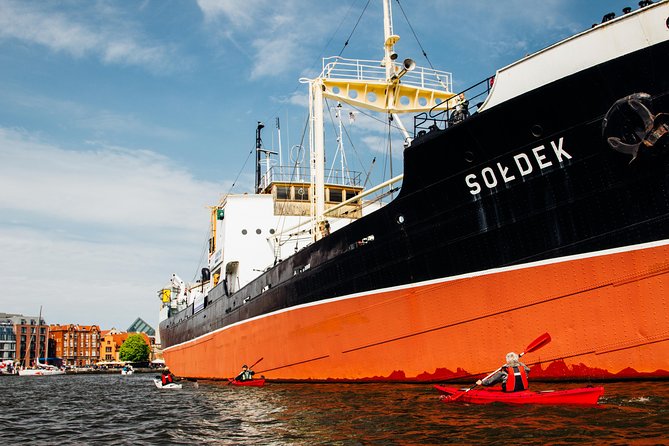
Gdansk sits where water does the heavy lifting. It’s not just scenery; it’s the reason the city grew at all—built on sea routes, river access, and the practical flow of goods. When you paddle on the Motława River, you feel that logic immediately. Land monuments look fixed; on the water, everything feels connected—quays, bridges, shipyard lanes, and the edges of the old city.
This tour does a smart thing: it doesn’t only show you pretty waterfront angles. It shows you how the city functions. You’ll see ship-related areas and working infrastructure, then shift to quieter island surroundings. That mix is what makes it feel like “real Gdansk” instead of a standard sightseeing loop.
Your Route: Crane, SS Sołdek, and the Remontowa Shipyard Area
Even before the full island paddling, the route focuses on water-side history and industry. You’ll pass or see the Crane, the SS Sołdek, and the Gdansk Remontowa Shipyard area—three stops that explain why this city looks the way it does.
You can also read our reviews of more tours and experiences in Gdansk.
The Crane: A medieval “human-powered” workhorse
The Crane is one of the defining symbols of Gdansk, tied to the city’s trading age. Built in the mid-15th century as part of a double-towered gate on the shoreline, it wasn’t just decorative. It was used to install/remove ships’ masts and to load or unload heavy cargo. The really striking detail here is its capacity: it could hoist loads up to 2000 kg, which made it the largest crane in medieval Europe.
From the kayak, you don’t just look at the structure—you understand the setting it was built for: a quay line where ships came in, cargo moved fast, and time mattered. It’s the difference between reading about trade and watching the waterline where trade happened.
SS Sołdek: A coal and ore freighter story
You’ll also see SS Sołdek, a Polish coal and ore freighter. This stop adds weight to the picture. Gdansk wasn’t only about polished old-town charm; it was powered by materials moved in large quantities. When you view it from the water, you’re seeing the kind of vessel that made industrial-scale logistics possible.
Remontowa Shipyard: Watching work in progress
Then comes the Remontowa Shipyard, still active and working. Seeing a real yard from the water is a big part of the value. You’re not just viewing ships in photos or on land. You’re close to the area where ferries and large vessels are repaired or constructed, watching people at work in a place that still has a job to do.
A kayak also lets you get a different viewing angle. Ferries can block sightlines, and land viewpoints don’t always show what’s happening beside the water. On the water, you can often track the motion of the yard itself—where activity is happening relative to the docks.
Granary Island and Ołowianka Island: The Best Part of the Paddle
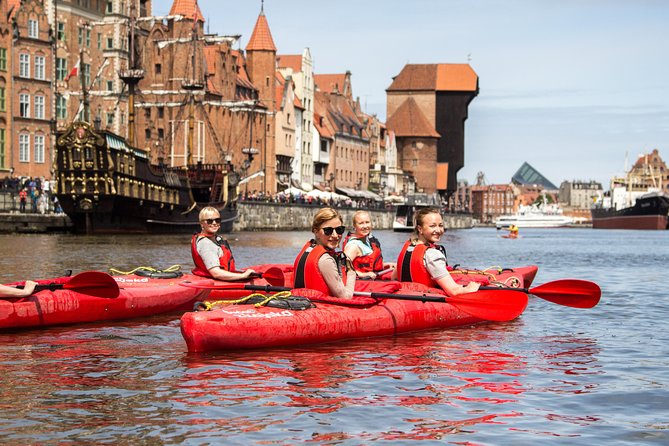
After the waterfront stops, the core experience shifts into pure paddling time. You’ll do an amazing kayak route through the river Motława around two islands: Granary Island and Ołowianka Island.
These islands matter because they change the mood of the tour. Land sightseeing keeps pulling your eyes toward buildings. Island paddling lets you slow down and pay attention to water movement and shoreline rhythm—bridge lines, edges of the banks, and how the river opens and tightens as you pass around land shapes.
You’ll also get something practical: a sense of scale. From the water, even familiar parts of Gdansk feel larger or more spaced out. That’s often when first-time paddlers say they suddenly “get it,” because your brain stops treating the city as a flat map and starts treating it as a set of connected routes.
Beginner-Friendly Coaching That Actually Helps
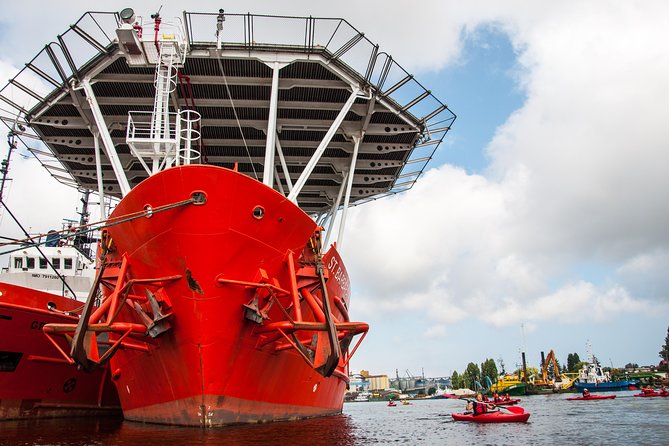
This isn’t a leave-you-alone-on-the-water tour. You’ll get top tips on simple paddling techniques, and the goal is to keep it approachable from the first minutes. The tone is important here: a good guide doesn’t just explain how to hold the paddle; they help you stay calm, then adjust your technique without turning it into a lecture.
In multiple trips, the experience was led by Szymon, who was described as welcoming and friendly right from arrival. The safety briefing is mandatory, and instruction is given in a way that helps you understand what you need to do before you start stroking for real. One group even noted that the pace was matched to the whole group while still letting different kayaks travel at slightly different rhythms.
If you’re a complete novice, this matters. Kayaking looks easy until you’re actually holding a paddle in moving water. Coaching before you go a full lap makes the workout feel manageable instead of exhausting.
Safety Briefing, Swimming Requirement, and the Rules That Keep It Smooth
Kayaking is fun partly because it’s controlled. That’s why the tour starts with a mandatory safety briefing, and late arrivals aren’t admitted. Plan to arrive a few minutes early so you can get through the briefing without feeling rushed.
Two key safety requirements that you should take seriously:
- You need to be able to swim to participate.
- There’s a 110 kg weight limit.
You also have behavioral rules that are typical for water activities, but worth knowing up front: no alcohol or drugs before or during the tour, and no smoking (including e-cigarettes). These aren’t just “liability checkboxes.” They’re about keeping everyone steady, warm, and focused on technique.
If you’re traveling with minors, they must be accompanied by an adult in the kayak. And everyone has to understand basic English, since the tour is offered in English.
Gear and Comfort: What You’ll Actually Feel During Those 2–3 Hours
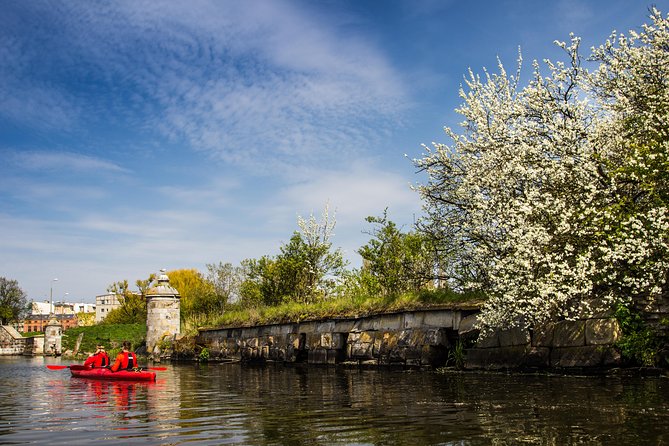
You’ll be provided with kayaking equipment, and the setup is described as high-quality. Some groups also mentioned receiving a dry suit, which helped keep them thoroughly dry and warm. That matters because on rivers, the weather can shift quickly, and being uncomfortable turns a fun paddle into a cold chore.
Most tours like this also include life vests. In one described company outing, participants were given life vests and felt safe, which lines up with the idea that safety is baked into the experience rather than added later.
A small detail I really like for tours like this: one trip included hot chocolate, described as a nice touch. It’s not the main reason to book, but it signals something important: the operator is paying attention to the full experience, not only the water time.
Timing and Effort: Plan for a Workout, Not a Float
The duration is listed as 2 to 3 hours. That range matters. You’re on the water long enough to feel the effort, but not so long that it becomes a grind.
In one account, the paddle was described as a workout but still manageable even for a complete novice. That matches what I’d expect: you’re doing enough strokes to move comfortably, correct your technique, and keep direction without being forced into sprint mode.
My practical advice: treat this like a light-to-moderate physical activity. You don’t need to be an athlete, but you should expect to use your upper body and core, especially during turns and when you’re settling into a steady rhythm.
Price and Value: What $145.12 Is Paying For
At $145.12 per person for a 2 to 3 hour private kayak tour, the price can look steep if you compare it to casual rentals. But this isn’t a self-guided experience.
You’re paying for:
- Guided coaching (including technique tips and safety briefing)
- Quality equipment (and possibly added warmth like a dry suit)
- The chance to see specific water-side landmarks tied to Gdansk’s industrial and trade story
- A private format, meaning the day isn’t competing with strangers for attention and pacing
- The ability to access areas ferries and land routes simply can’t show well
If your priority is a thoughtful, water-level tour where you actually understand what you’re seeing—and you want that help without renting gear and figuring everything out yourself—this price starts to make sense fast.
Who This Tour Fits Best (and Who Might Reconsider)
This is a great match if you want:
- A beginner-friendly introduction to kayaking
- A guided route that mixes old waterfront icons with shipyard views
- A different angle on Gdansk than typical walking routes
- A private group format for a more relaxed pace
You might reconsider if:
- You’re not comfortable swimming, since that’s a participation requirement
- You want zero physical effort (this is a real paddle)
- You’re unable to understand basic English, since the tour is in English
Should You Book Islands of Gdansk Private Kayak Tour?
I’d book it if you want a Gdansk experience that’s built around the water, not just near it. The combination of Motława River paddling, island time at Granary Island and Ołowianka Island, and water-side stops like the Crane, SS Sołdek, and the Remontowa Shipyard area gives you a full picture of how the city works.
It’s especially worth it if you’re new to kayaking and want training and pacing help from a friendly, professional guide such as Szymon. Just be honest with yourself about the swim requirement and plan for a light workout.
If those boxes fit, you’ll leave with the kind of memories that stay in your head because you experienced the city’s waterlines directly.
FAQ
How long is the Islands of Gdansk private kayak tour?
The tour lasts about 2 to 3 hours.
What is the price per person?
The price is $145.12 per person.
Where does the tour start?
The meeting point is at Around Gdansk | Kayak Tours & Adventures, Dokowa 1, 80-863 Gdańsk, Poland.
What waterways and islands will we see?
You’ll paddle on the river Motława and kayak around Granary Island and Ołowianka Island.
What stops will be included during the route?
You’ll see the Crane, SS Sołdek, and the Gdansk Remontowa Shipyard area as part of the tour.
Is this tour beginner-friendly?
Yes. You’ll get tips on simple paddling techniques, and most travelers can participate.
Do I need to know English?
Yes. Everyone has to understand basic English, and the tour is offered in English.
What are the key safety requirements?
You’ll do a mandatory safety briefing. You also have to be able to swim, and there’s a 110 kg weight limit. Alcohol, drugs, and intoxicating substances are strictly forbidden before and during the tour, and smoking is not allowed.
What happens if the weather is bad?
This experience requires good weather. If it’s canceled due to poor weather, you’ll be offered a different date or a full refund.
What is the cancellation window for a full refund?
You can cancel for a full refund up to 24 hours in advance. If you cancel less than 24 hours before the start time, the amount paid isn’t refunded.